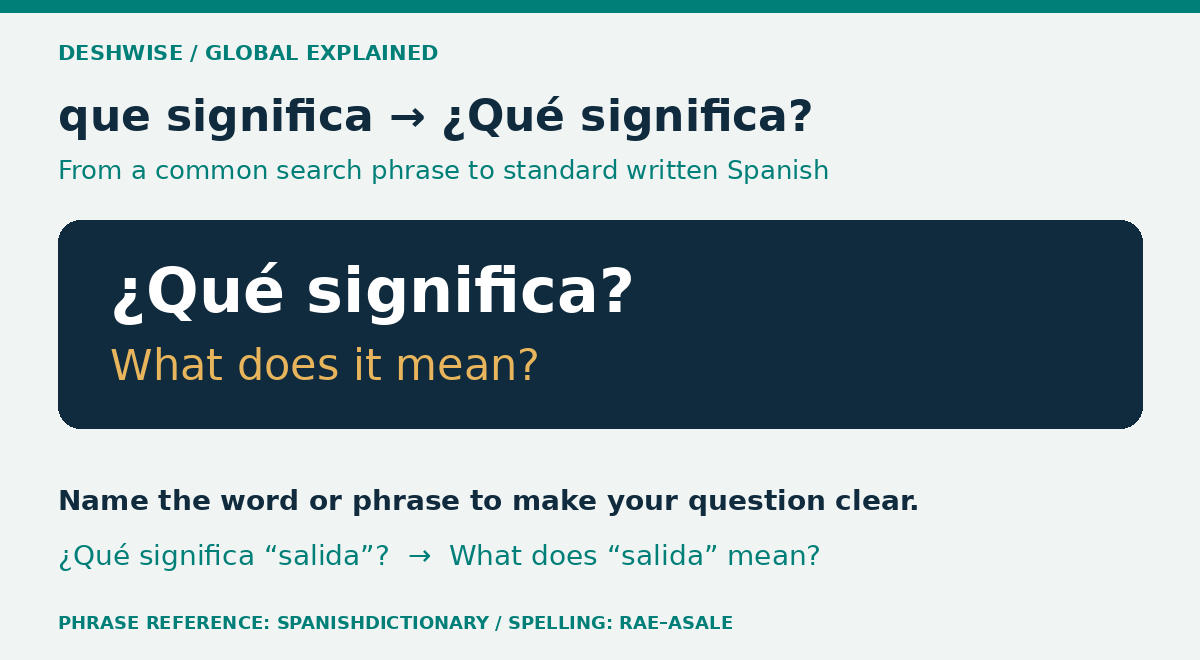
¿Qué significa?
What does it mean?
Searching for que significa in English? The standard direct question is ¿Qué significa? Use it to ask the meaning of a word, phrase, sign or symbol.
Choose Listen to hear the phrase or Copy to save it.
How to pronounce ¿Qué significa?
keh seeg-nee-FEE-kah
Break the phrase into qué · sig · ni · fi · ca. Put the main stress of significa on fi. The English-style spelling above is an approximation, rather than an exact record of every Spanish sound.
Listen uses a Spanish device voice when available. It is synthetic speech, not a recording of a native speaker.
Que significa in English: four useful patterns
| Spanish | English | Use |
|---|---|---|
| ¿Qué significa? | What does it mean? | A direct question when the topic is already clear. |
| ¿Qué significa…? | What does … mean? | Add the exact word or expression you want explained. |
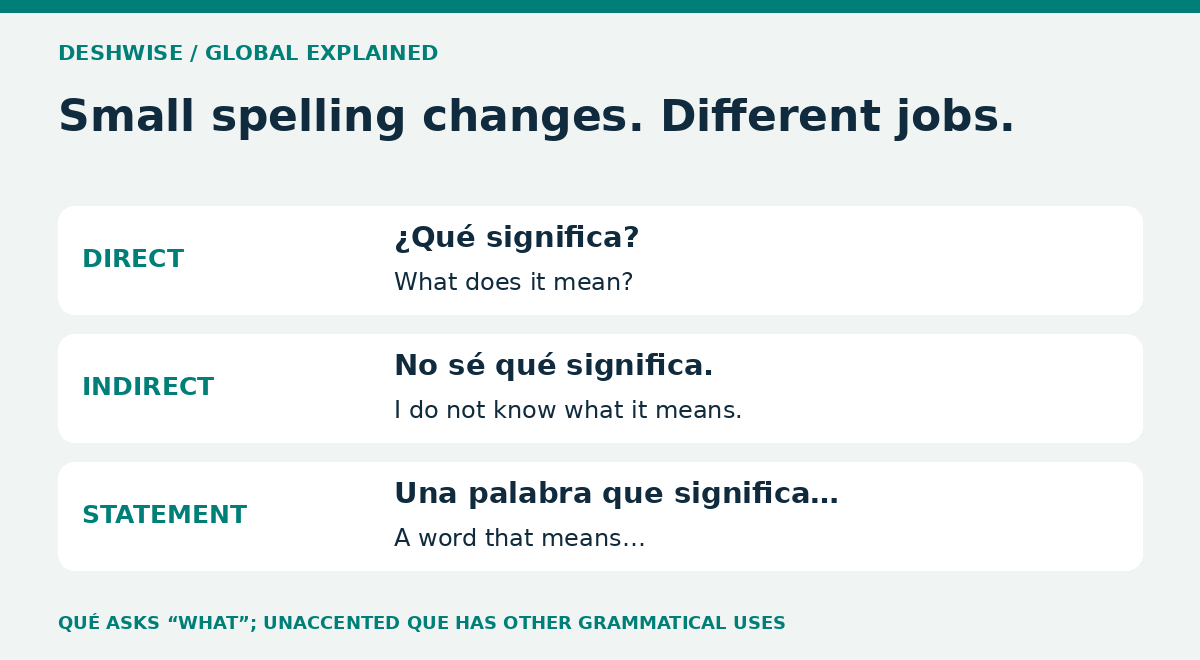
| No sé qué significa. | I do not know what it means. | An indirect question within a statement. |
| Una palabra que significa… | A word that means… | Unaccented “que” connects a description, rather than asking “what.” |
Do not confuse ¿Qué significa? with ¿Qué quieres decir?, which asks “What do you mean?” The first usually asks about the meaning of an item; the second asks about a speaker’s intention. The detailed guide below explains how context changes the choice.
Spanish-English examples you can use
These original examples show the phrase in short, practical sentences. Listen to a sentence, read its English meaning and copy the Spanish to your own notes. Keep the accent and question marks when using a direct question.
¿Qué significa “hola”?
What does “hola” mean?
“Hola” means “hello.”
¿Qué significa “prohibido”?
What does “prohibido” mean?
On a sign, it means “prohibited” or “forbidden.”
¿Qué significa eso?
What does that mean?
Use it when the other person knows what “that” refers to.
¿Qué significan estas palabras?
What do these words mean?
The plural “palabras” takes “significan.”
¿Qué significa “bienvenido” en inglés?
What does “bienvenido” mean in English?
“Bienvenido” means “welcome” when addressing one male person.
Disculpe, ¿qué significa esta palabra?
Excuse me, what does this word mean?
A polite way to ask someone for help with a word.
No entiendo qué significa.
I do not understand what it means.
The accent stays on “qué,” even inside this statement.
Es una palabra que significa “luz”.
It is a word that means “light.”
Here “que” means “that” and does not take an accent.
Use these as sentence patterns, not as a claim that every Spanish word has only one English equivalent. Quoting the exact expression and giving its context helps the other person choose a useful explanation.
Detailed meaning, grammar and everyday usage
“que significa” usually represents the Spanish question “¿Qué significa?”—“What does it mean?” Add a word or phrase after it, and you are asking what that particular expression means. For example, ¿Qué significa “gracias”? asks, “What does ‘gracias’ mean?”
There is one important distinction. You may be looking for the English meaning of this Spanish question, or you may have typed it because you want the meaning of something else. If it is the second, keep the unfamiliar word and its surrounding sentence: those details determine the answer.
This guide explains the phrase in English, shows the standard written form, and gives original examples you can adapt for conversations, travel, messages and subtitles. The phrase translation is supported by SpanishDictionary's entry; spelling and grammar references come from the Real Academia Española and ASALE.
Two words, one practical question
The phrase becomes easier to remember when you understand its parts. Qué supplies the question “what.” Significa is a form of significar, the verb used for meaning or signifying something. The RAE dictionary entry for significar explains the verb's uses.
Spanish does not build this question by translating every English word separately. The English helper “does” does not require an extra Spanish word here. Learn the complete pattern rather than trying to assemble “what + does + it + mean” one piece at a time.
| Spanish question | Natural English meaning | When to use it |
|---|---|---|
| ¿Qué significa? | What does it mean? | The thing being discussed is already clear |
| ¿Qué significa eso? | What does that mean? | You are referring to something just mentioned |
| ¿Qué significa esta palabra? | What does this word mean? | You can point to a word |
| ¿Qué significa “salida”? | What does “salida” mean? | You can name the exact unfamiliar expression |
The last version is often the most useful for a learner because it removes uncertainty about what you want explained.
Why the accent in “qué” matters
People often omit accents when typing a quick search. That explains the common search form que significa, but the standard direct question is ¿Qué significa? The accent on qué is part of correct spelling.
The RAE's entry for qué identifies its interrogative use and distinguishes it from unaccented que in other grammatical roles. Compare these two original examples:
- ¿Qué significa “mapa”? — What does “mapa” mean?
- Es una palabra que significa “map”. — It is a word that means “map.”
The first qué asks a question. The second que connects information about a word. They look similar, but they are doing different jobs.
You also keep the accent in an indirect question: No sé qué significa means “I don't know what it means.” There are no question marks because the whole sentence is a statement, but the embedded “what” still has interrogative meaning.
Why Spanish uses two question marks
In standard written Spanish, a direct question has an opening ¿ and a closing ? The RAE's punctuation guide explains this paired system.
Write ¿Qué significa esta palabra? when asking the question directly. Write No entiendo qué significa esta palabra. when making the statement “I don't understand what this word means.”
The punctuation helps a reader see where the question begins. It is especially useful in a longer message that contains both a statement and a question: Estoy leyendo un menú. ¿Qué significa “sin”? That means, “I'm reading a menu. What does ‘sin’ mean?”
You do not need to make a casual conversation feel like a grammar test. However, including the accent and both question marks is a good habit in learning notes, schoolwork and messages where you want your Spanish to be clear.
Significa or significan: which form do you need?
Use significa with a singular subject and significan with a plural subject in the examples below. You can check both forms in the conjugation of significar.
- ¿Qué significa esta palabra? — What does this word mean?
- ¿Qué significan estas palabras? — What do these words mean?
- ¿Qué significa este símbolo? — What does this symbol mean?
- ¿Qué significan estos símbolos? — What do these symbols mean?
Look at what you are asking about: one word or several words, one symbol or several symbols. That tells you which form fits these patterns.
A phrase containing several words can still be treated as one expression: ¿Qué significa esta frase? asks about “this phrase,” which is singular. Do not count the words inside the expression and automatically change the verb to significan.
As a practical beginner's template, keep ¿Qué significa…? for one unfamiliar item. When you want several separate items explained, use ¿Qué significan…? and identify them clearly.
Everyday situations where the phrase helps
Reading a sign while travelling
Imagine that you see salida above a doorway. Ask ¿Qué significa “salida”? In that setting, the answer is “exit.” Naming the word is better than saying only “What does that mean?” when several signs are visible.
Once you know the meaning, connect it with the situation: “This sign marks the exit.” That gives you something useful to remember instead of a translation floating without context.
Looking at a menu
You see sin azúcar and want to understand it. Ask ¿Qué significa “sin azúcar”? The expression means “without sugar.” You could follow up with ¿Puede explicarlo?, meaning “Can you explain it?”
If your question concerns an allergy or another important dietary requirement, ask the staff directly about the actual ingredients. Understanding a phrase on a menu is only one part of understanding what a dish contains.
Reading a friend's message
Suppose a message includes nos vemos mañana. You can ask about the whole expression, which means “see you tomorrow,” instead of requesting three disconnected word definitions.
When friends are in different time zones, “tomorrow” may need a date attached. Our what is today guide explains how to make those calendar references clear across locations.
Watching something in Spanish
Pause after a line you want to understand and note the complete sentence. Ask ¿Qué significa esta frase en esta escena?—“What does this phrase mean in this scene?” That question makes room for tone and context.
If you are choosing a Spanish-language series, our what to watch guide includes Money Heist and explains how to check audio and subtitle options. Start with a manageable excerpt rather than trying to translate an entire episode at once.
Meaning, translation and intention are different questions
¿Qué significa…? asks about meaning. ¿Cómo se dice… en inglés? asks how to say something in English. ¿Qué quieres decir? asks “What do you mean?” and focuses on the other person's intended message.
For example, you may understand every word in a sentence and still be unsure whether a friend is making a joke. A dictionary definition will not necessarily answer that. Asking what the speaker means can be more helpful than asking for another translation.
Likewise, if you already know the object but need its English name, ask for the English expression directly. Choose the question that matches the gap in your understanding.
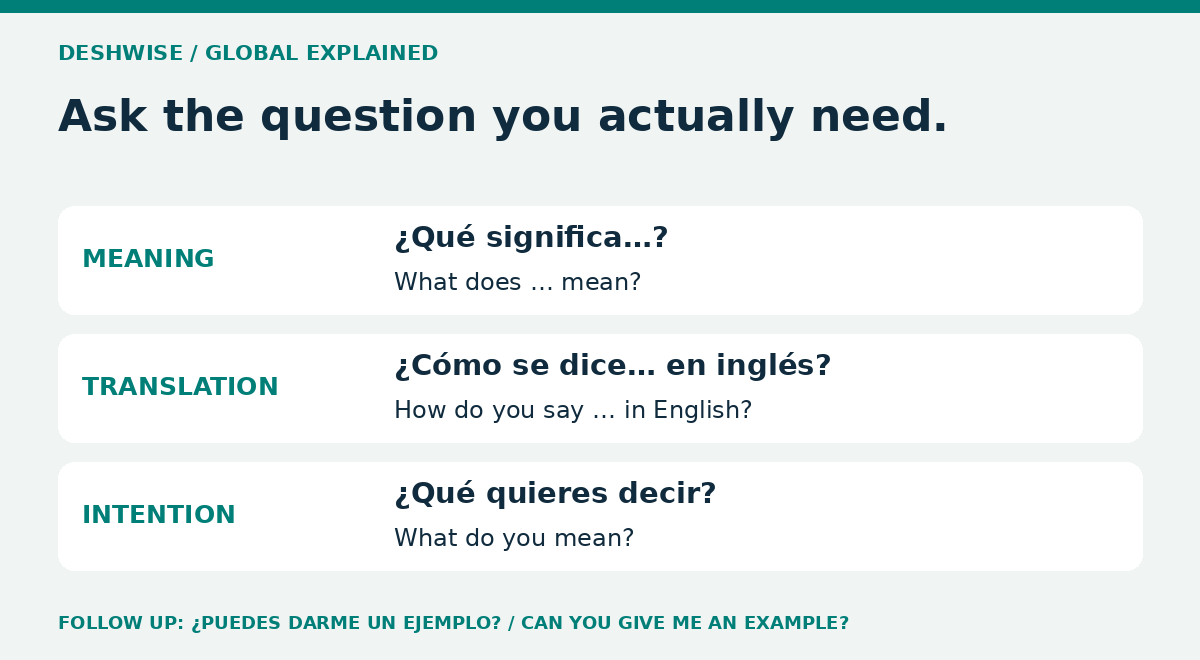
A useful polite follow-up is ¿Puedes darme un ejemplo?—“Can you give me an example?” An example often reveals how a word is used more clearly than a second definition with equally unfamiliar vocabulary.
How to get a better answer from a dictionary or translator
Begin with the smallest complete piece of language that preserves the meaning. A single word may be enough for a label; a sentence may be necessary for a joke, idiom or message. Then follow this practical sequence:
- Copy the expression accurately. Keep accents and punctuation where possible.
- Read the surrounding sentence. Identify who is speaking and what is happening.
- Check more than the first result. Look for a meaning that fits this particular situation.
- Read an example. Compare its use with the expression you encountered.
- Ask a focused follow-up. Explain what still seems unclear instead of repeating the same search.
Do not assume the shortest English equivalent works everywhere. A translation that fits a sign may sound unnatural in a conversation. When you save a new word, keep one original sentence with it so you can remember the setting.
For an important document, use appropriate human language assistance rather than relying on an uncertain phrase-level guess. A fluent-looking translation can still miss the intended meaning.
Why context changes the answer: banco and mañana
The RAE entry for banco includes both a financial institution and a seat for several people. In El banco está cerrado, the natural reading may be “The bank is closed.” In Nos sentamos en un banco, it is “We sat on a bench.” The surrounding words do essential work.
Similarly, mañana can refer to morning or tomorrow. Trabajo por la mañana means “I work in the morning”; Trabajo mañana means “I work tomorrow.” These original examples show why copying the full expression helps.
When someone gives you a meaning that does not fit, ask ¿Y en esta frase?—“And in this sentence?” You are not necessarily looking at a wrong dictionary entry; you may simply need a different sense of the word.
A short conversation you can adapt
Learner: Perdona, ¿qué significa “entrada” aquí?
English: Excuse me, what does “entrada” mean here?
Speaker: Aquí significa “entrance”.
English: Here it means “entrance.”
Learner: Gracias. ¿Puedes darme otro ejemplo?
English: Thank you. Can you give me another example?
The most useful word in this exchange is aquí, or “here.” It tells the other person that you are asking about a particular use, not every possible dictionary meaning. You can replace entrada with another word while keeping the rest of the question.
If you are writing to someone you address more formally, ¿Puede darme un ejemplo? uses the formal usted form. Match your tone to the conversation rather than adding a complicated introduction you do not yet understand.
Common mistakes that make the question less clear
Leaving out the item: “What does it mean?” works only when the other person knows what “it” refers to. Quote the word or point to it.
Changing the meaning accidentally: Asking “What do you mean?” can sound like a challenge in some contexts. If you simply need vocabulary help, identify the unfamiliar word and ask about that.
Treating one translation as universal: Keep the sentence and situation. The person explaining may need both to choose the appropriate meaning.
Stopping before you can use it: After receiving an explanation, try your own short sentence and ask whether it fits. That turns recognition into something you can use in another conversation.
Frequently asked questions
Is “que significa” incorrect?
It is a common unaccented search form. For the standard direct question, write ¿Qué significa? If you are using que significa inside a statement such as “a word that means…,” the unaccented form can be correct.
Can I use it for a symbol or an abbreviation?
Yes. Identify the item and add its context: a symbol on a map, an abbreviation in a message, or a label in an app. The same item can have different meanings in different settings.
How can I practise without memorizing long lists?
Choose three unfamiliar expressions from something you actually read. Ask what each means, keep one example sentence, and revisit it later. A small set you can explain and use is more valuable than a long list you cannot connect to a real conversation.
Sources and references
Original grammar references checked 9 October 2026; translation and pronunciation reviewed 30 October 2026. Links appear beside the explanations they support.