For a US federal individual income-tax refund, start at IRS.gov/refunds. Use the official tracker or the account option linked there. Deshwise cannot look up your tax record, release a payment or speed up IRS processing, and this page does not collect tax information.
The most useful next step depends on what has happened already: whether your return was accepted, whether the tracker can find it, whether the refund has been approved, or whether a payment was sent but has not arrived. Those situations need different responses.
This guide explains the where's my refund process using official IRS, USA.gov and Taxpayer Advocate Service references checked on 9 October 2026. It covers US federal individual returns; a state refund, amended return or retail purchase refund may require a different system.
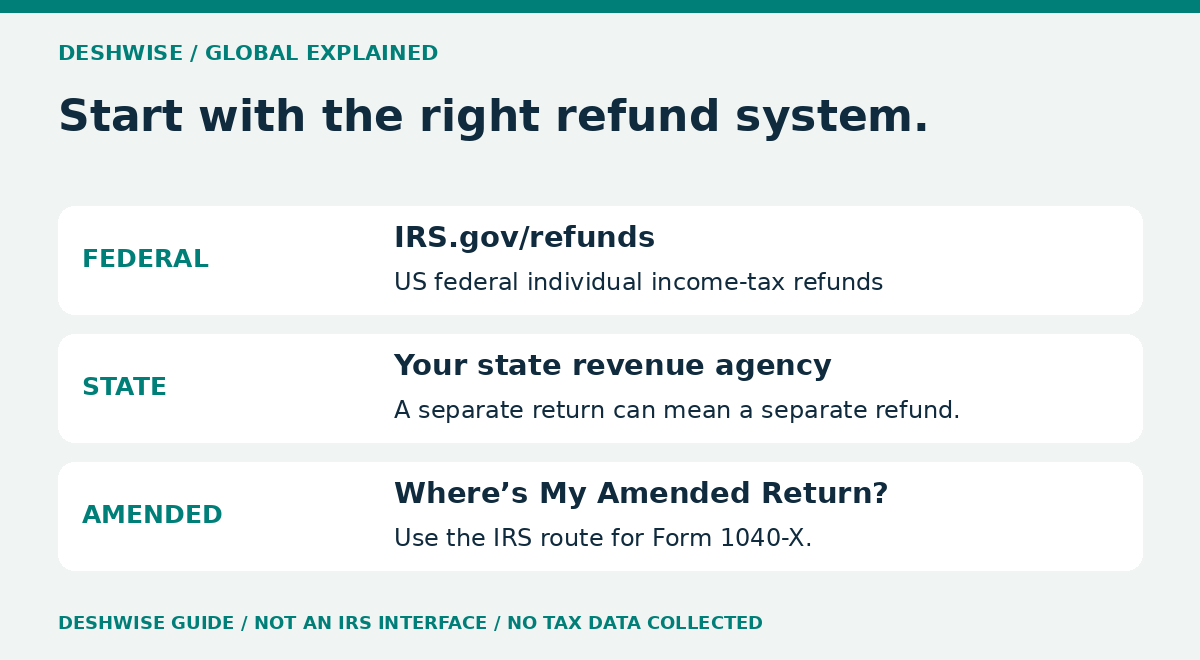
Before checking: make sure you have the right refund
A federal return and a state return are separate records. Receiving one refund does not establish when the other will arrive. USA.gov's refund-status guide directs readers to the IRS for federal refunds and to state authorities for state refunds.
Look at the return or receipt in front of you. Does it identify the IRS, a state revenue agency, or a merchant? Start with that organization. A search result using the words “refund status” does not necessarily belong to the system you need.
For a state refund, use the state-agency link from an official government source. For a corrected federal individual return filed on Form 1040-X, see the amended-return section below. Keeping these routes separate prevents repeated searches in a tool that cannot display your particular record.
What information should you have ready?
Use your filed return rather than an early estimate from tax software. The official process asks for identifying and return-specific details, including your Social Security number or ITIN, filing status, tax year and exact refund amount. Follow the tool's instructions for entering the amount; the tracker guidance specifies whole dollars.
Keep these details private. You do not need to post a screenshot of your return in a comment thread to ask a general question about the process.
Prepare a small record for yourself:
- The tax year and filing method.
- The date you submitted the return and any acceptance confirmation.
- The refund amount shown on the filed return.
- The most recent tracker message and the date you checked it.
- Any IRS notice number and response deadline.
This record helps you describe the problem clearly if you later contact the IRS or your tax preparer. It also stops a federal amount from being confused with a combined federal-and-state estimate.
When will refund status first appear?
The waiting period for a tracker result is not the waiting period for your money. On its refund page, the IRS lists these starting points:
| Filing situation | When to start checking status |
|---|---|
| E-filed current-year return | About 24 hours after e-filing |
| E-filed prior-year return | Allow several days; IRS pages currently say 3 days or 3–4 days |
| Paper return | About 4 weeks after filing |
The prior-year wording differs slightly between the main page and the tracker explainer. Allow the stated window and follow the current instructions shown by the IRS. None of these intervals promises approval or payment by that point.
If you submitted a return very recently, an unavailable result alone does not tell you that the refund has been lost. First confirm your filing information and whether the relevant status window has passed.
How to check your status safely
Open the IRS refund page yourself and choose the official tracking route. Enter the requested details only after confirming that you reached the IRS service from its own website. Keep a copy of the filed return nearby so you can compare entries carefully.
Read the complete response. A status heading is useful, but an accompanying instruction or date may be the part that determines your next step. Save the wording privately rather than relying on memory.
According to USA.gov, the refund systems update once every 24 hours. Rechecking every few minutes will not create a new result. Choose a reasonable daily check and use the remaining time to handle any instruction the IRS has actually provided.
If you encounter an input mismatch, compare the year, filing status and refund amount with the filed return. Do not keep trying different estimated amounts. If a preparer filed for you, ask for the final submitted copy and acceptance information.
What the three refund stages mean
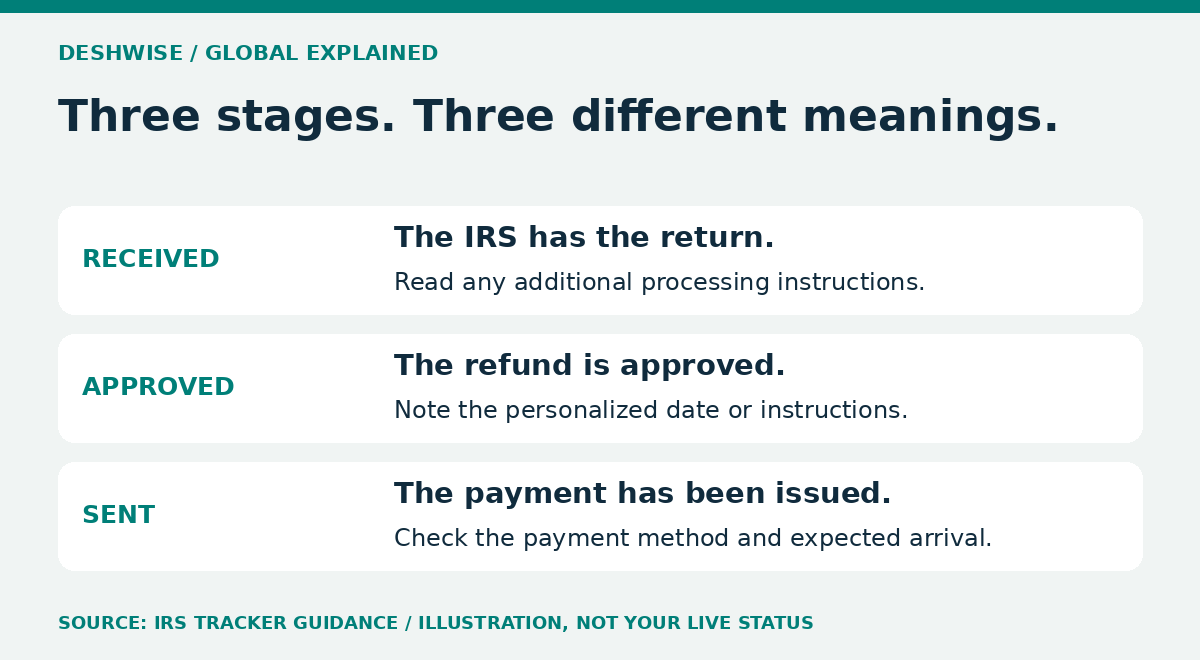
The IRS tracker explainer describes three stages. Read them as progress information, not interchangeable confirmations:
| Tracker stage | Meaning | Useful next action |
|---|---|---|
| Return Received | The IRS has the return for processing | Read any additional instructions |
| Refund Approved | The refund has been approved | Note the personalized date or instructions |
| Refund Sent | The payment has been issued | Check its method and expected arrival information |
Acceptance of an electronically filed return is not the same thing as approval of the refund. Similarly, approval is not proof that the funds are already available in your bank account.
For planning purposes, separate submitted, accepted, approved and received in your notes. If someone asks what happened, those specific words communicate more than “it went through.” The tracker cannot replace checking your own account for an actual credit.
How long does the refund itself take?
The IRS processing-status page says electronically filed individual Form 1040 returns are generally processed within 21 days. That is a general processing expectation, not a guaranteed payment appointment for every taxpayer.
Paper returns follow a different timetable. The main refund page currently describes six or more weeks from receipt for mailed returns. Corrections, additional review and other special handling can extend the process.
Do not turn a general estimate into a promise to a landlord, lender or seller. Use the personalized information provided for your return, and keep room for the difference between an issued refund and money actually reaching you.
For paper processing, check the IRS's current processing-status page rather than a screenshot from an earlier month. Its published workload information can change. A general queue update still does not tell you the exact completion date for an individual case.
If your refund seems delayed
Start with the current message, not with someone else's timeline. Two returns filed on the same date can need different handling. A friend's payment is not evidence that yours has been overlooked.
The Taxpayer Advocate Service's missing-refund guide recommends checking the official status first. Its general phone-contact guidance is to wait at least 21 days after electronic filing or six weeks after mailing. If the tracker or an IRS notice directs you to take action, follow that instruction.
Before contacting the IRS, write down one clear question: “The tracker says ___, I filed on ___, and the instruction I need help with is ___.” Keep relevant documents available. This is more useful than asking only why another person received a refund sooner.
Avoid sending another copy of the same original return simply to try to move the process along. If you believe the return needs correction, distinguish that issue from a status inquiry and check the proper procedure with the IRS or a qualified tax professional.
If the IRS asks you to verify your identity
An identity-verification request needs attention; checking the tracker repeatedly does not complete verification. The IRS's CP5071-series notice guide explains that the agency may need to confirm both identity and the tax return before processing can continue.
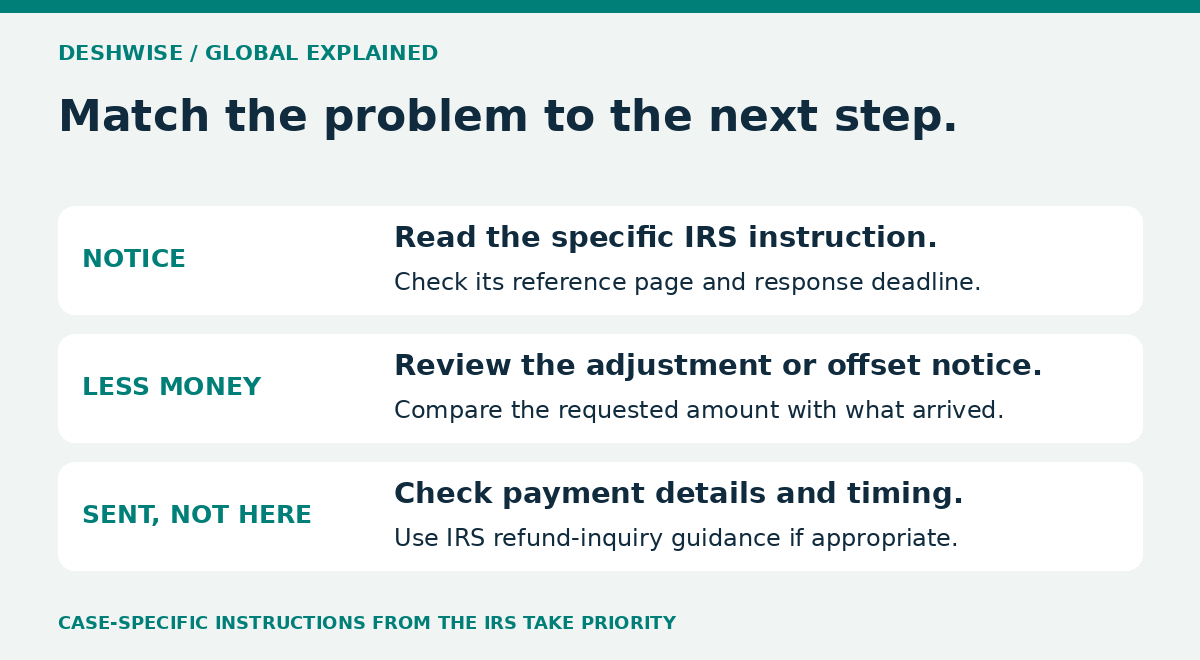
Follow the instructions on your specific notice and check its reference page on IRS.gov. Have the notice and the requested tax records ready. Do not assume that a general account sign-in has fulfilled every requirement stated in the letter.
If you did not file the return described in the notice, the IRS says to verify that with the agency too; identity theft may be involved. Use the official route provided for the situation. Never send identity documents to an unknown person offering to “clear” the problem through social media.
If the refund amount is smaller than expected
A reduced refund is different from a missing payment. The IRS reduced-refund guide explains two broad possibilities: an adjustment to the return, or a reduction associated with a debt.
An adjustment might involve a calculation or a credit. A debt offset can involve obligations handled through the Treasury Offset Program. The notice matters because it identifies what changed and which organization should handle questions.
Compare three amounts: what the filed return requested, what the notice says was approved or adjusted, and what actually arrived. Keep the notice with that comparison.
If you disagree, read the response instructions and deadline rather than assuming the bank can restore the difference. The IRS's notice-and-letter guide explains how to review correspondence and respond. A tax professional can help interpret a disputed adjustment in your specific case.
If it says sent, but the money has not arrived
Read the payment details and expected timing shown for your refund. Then check the relevant bank account or delivery information. The issue is now locating an issued payment, which is different from waiting for the IRS to approve the return.
Use the official IRS refund-inquiry guidance if the expected window has passed. A refund trace may be appropriate in some situations, and the procedure can depend on the filing status and payment circumstances.
Do not submit a random replacement claim or follow a stranger's payment-recovery link. Explain the issued date and the problem through the official channel. Keep records of any contact with the bank or IRS so you do not have to reconstruct the sequence later.
Amended returns and financial hardship
For Form 1040-X, use Where's My Amended Return?, rather than expecting the ordinary refund tracker to display the amendment. The IRS says amended-return status is available about three weeks after submission. That is the status-availability window, not a completion promise.
If an unresolved federal tax problem is causing financial hardship, the Taxpayer Advocate Service may be able to help, depending on the circumstances. It is an independent organization within the IRS, not a paid shortcut for every delayed refund. Review its eligibility and contact information before requesting assistance.
Protect your information while you wait
Refund uncertainty can make urgent messages sound convincing. The IRS scam guide warns about impersonation and misleading refund claims. Be wary of anyone promising a guaranteed release date in exchange for money or account access.
Start from IRS.gov when checking a message. Do not publish your tax identifier, bank details or login codes. For a related explanation of deceptive payment requests, Deshwise's online-payment fraud guide is available in Hindi/Hinglish; its India-specific reporting routes do not replace US tax procedures.
Your next step should follow the evidence: check the correct tracker, read its complete message, respond to a genuine notice, and use the official support route when appropriate. For general questions about dates and time zones, see what is today. For case-specific tax decisions, rely on the IRS and qualified professional advice.
Sources and references
Checked 9 October 2026. Links also appear beside the explanations they support.