
To make a budget, total your reliable take-home income, list your expenses and saving goals, and assign money to each before the next payday. Compare the plan with actual spending regularly and adjust it when your income, bills, or priorities change.
A budget does not need to predict everything perfectly. Its job is to show what your money must cover, which choices remain, and whether the plan fits the cash you actually have.
You can use paper, a spreadsheet, or an app. The steps work in dollars, pounds, Canadian or Australian dollars, rupees, and other currencies. Examples below use separate dollar and rupee households, not currency conversions or recommended living costs.
Key Takeaways
- Start with money available after relevant taxes and deductions, not headline salary.
- Include irregular bills, debt minimums, saving goals, and payment dates.
- The 50/30/20 rule is a guide; it may not fit your essential costs.
- Zero-based budgeting gives all available money a purpose, including savings.
- Review actual spending and timing rather than repeatedly rewriting an ideal plan.
Financial note: This is general educational information, not personalized financial, investment, tax, or debt advice. Local rules and circumstances differ. Seek qualified local guidance for serious debt problems, tax questions, or major financial decisions.
Choose a budgeting method
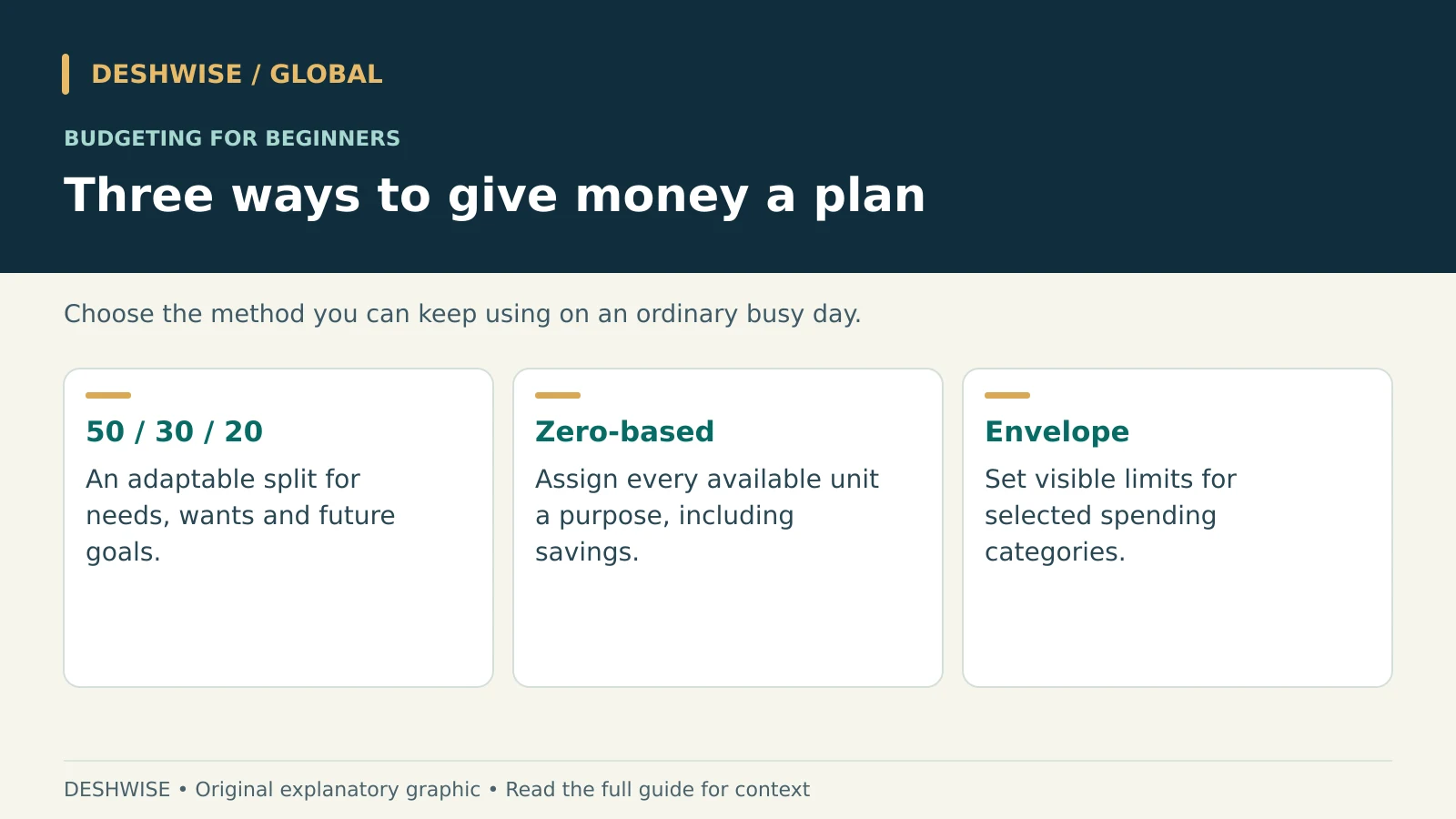
You do not have to choose the most detailed system. Pick one you can maintain when life is busy, and combine methods if that helps.
| Method | How it works | Useful when | Watch out for |
|---|---|---|---|
| 50/30/20 | Groups take-home income into needs, wants and future goals | You want a broad overview | Local essential costs may exceed the guideline |
| Zero-based | Assigns every available unit of money a purpose | You need close control or have several priorities | Too many categories can become burdensome |
| Envelope | Sets limits for selected spending categories | Variable spending tends to drift | Cash or digital limits still need reconciliation |
The 50/30/20 rule
A common version of the 50/30/20 framework allocates 50% of take-home income to needs, 30% to wants, and 20% to savings and extra debt repayment. In this guide, required minimum debt payments sit within needs; extra repayment sits within future goals. Keep that convention consistent to avoid double counting.
Needs might include basic housing, utilities, food, essential transport, insurance, and necessary healthcare. Wants might include optional subscriptions, entertainment, and nonessential upgrades. A category can contain both: basic transport may be necessary while a more expensive option is a choice.
These percentages are not a financial pass-or-fail score. If rent, disability-related costs, childcare, or family responsibilities push needs higher, record reality first. Adjust the split and identify achievable changes rather than making the spreadsheet look compliant.
Zero-based budgeting
Zero-based budgeting means available income minus planned allocations equals zero. Savings, annual-bill reserves, and a small cash buffer all count as allocations. It does not mean spending everything or emptying the bank account.
If you have $2,000 available, you might assign $1,400 to essentials, $250 to flexible spending, $200 to saving, and $150 to upcoming bills. The unassigned amount is zero while some money remains intentionally unspent.
The envelope budgeting method
Set a limit for a category such as groceries or eating out. Use a physical envelope or a digital record to track the amount left. When the category is empty, pause spending or explicitly move money from another category.
The method is about visible limits, not necessarily cash. Digital envelopes can work with cards or UPI if every transaction updates the balance. Avoid carrying large cash amounts, and check whether extra bank accounts or transfers attract fees.
Build your budget in seven steps
1. Establish your available income
Use payslips, benefit statements, invoices, or other reliable records. For an employed household, begin with regular take-home pay. Do not include a hoped-for bonus, unconfirmed sale, or unused credit limit as available income.
If tax is not deducted from your earnings, set aside an appropriate provision using local tax guidance before treating the remainder as spendable. Business revenue is not automatically personal income: expenses and obligations come first.
For weekly pay, multiplying by 52 and dividing by 12 estimates average monthly income. For fortnightly pay, use 26 divided by 12. An average helps planning, but your actual payday calendar still determines which bills can be paid this week.
Payroll deductions need a consistent approach. If pension or insurance deductions are already excluded from take-home pay, do not subtract them again. You may track them separately for a fuller picture without counting them twice in the spending plan.
2. Track expenses from records
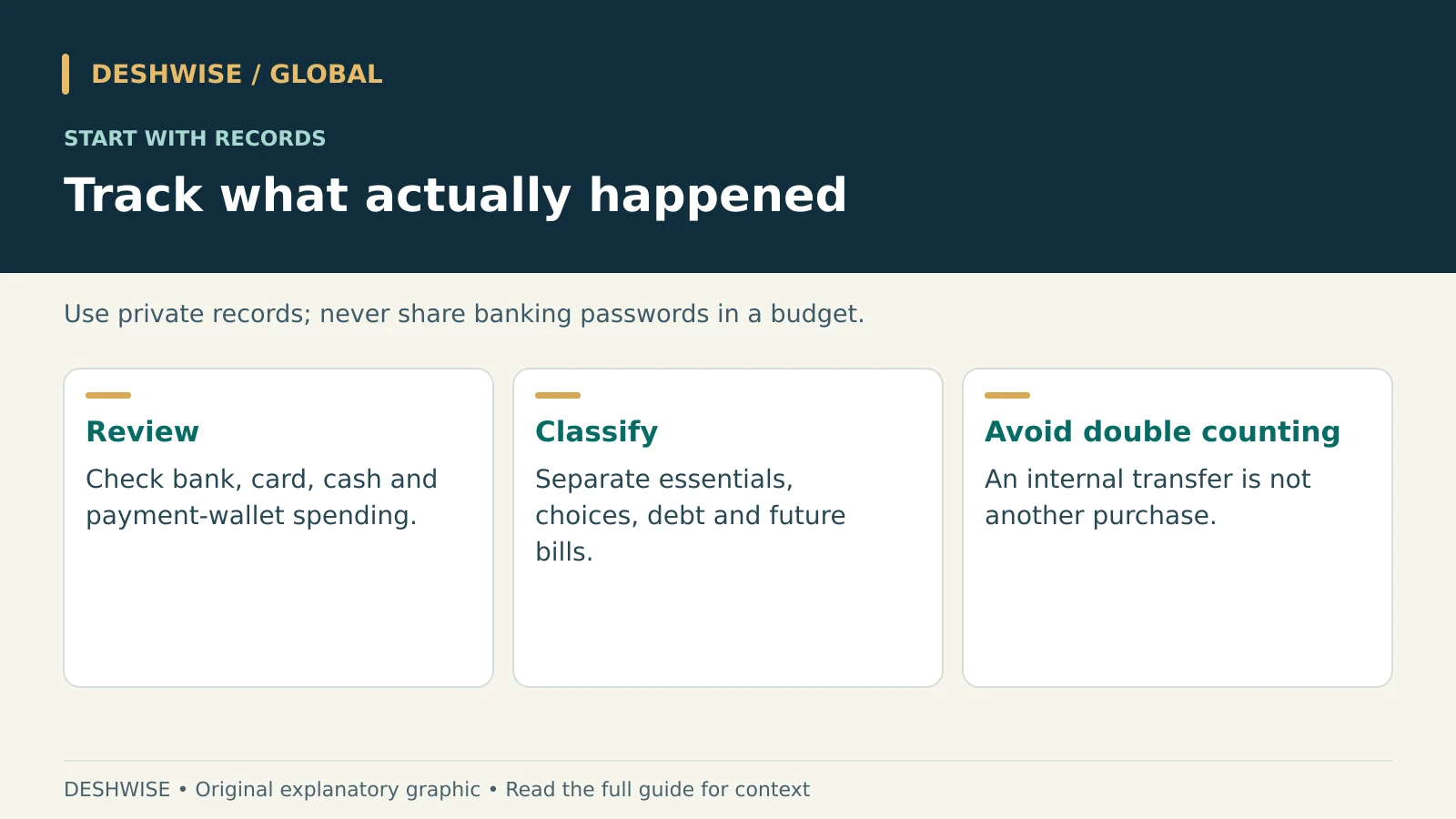
Review recent bank, card, wallet, and cash records. A month is a useful starting point, but several months or a full year may reveal seasonal and annual expenses. You do not have to delay starting while gathering perfect data.
List fixed bills, variable essentials, optional spending, debt minimums, and transfers. Check small recurring charges, delivery fees, family support, and purchases made through payment wallets.
Separate transfers between your own accounts from real spending. Likewise, if you record card purchases individually, paying the card bill is not a second expense. Interest, fees, and repayment of old balances need their own treatment.
3. Separate obligations, choices and future costs
Create a short category list you understand. Housing, bills, food, transport, debt, personal spending, and future goals may be enough to begin.
Include expenses that happen less often: insurance renewals, school costs, maintenance, celebrations, annual subscriptions, and travel commitments. These are often predictable even when they are not monthly.
Use a sinking fund for an expected bill. If a $600 payment is due in six months and you have nothing saved for it, allocating $100 a month prepares for it. A ₹12,000 bill due in six months needs ₹2,000 monthly under the same assumption. These are separate examples.
An emergency fund has a different role: it provides a reserve for genuinely unexpected needs. Do not call every annual bill an emergency or count the same savings toward several incompatible goals.
4. Add a bill calendar
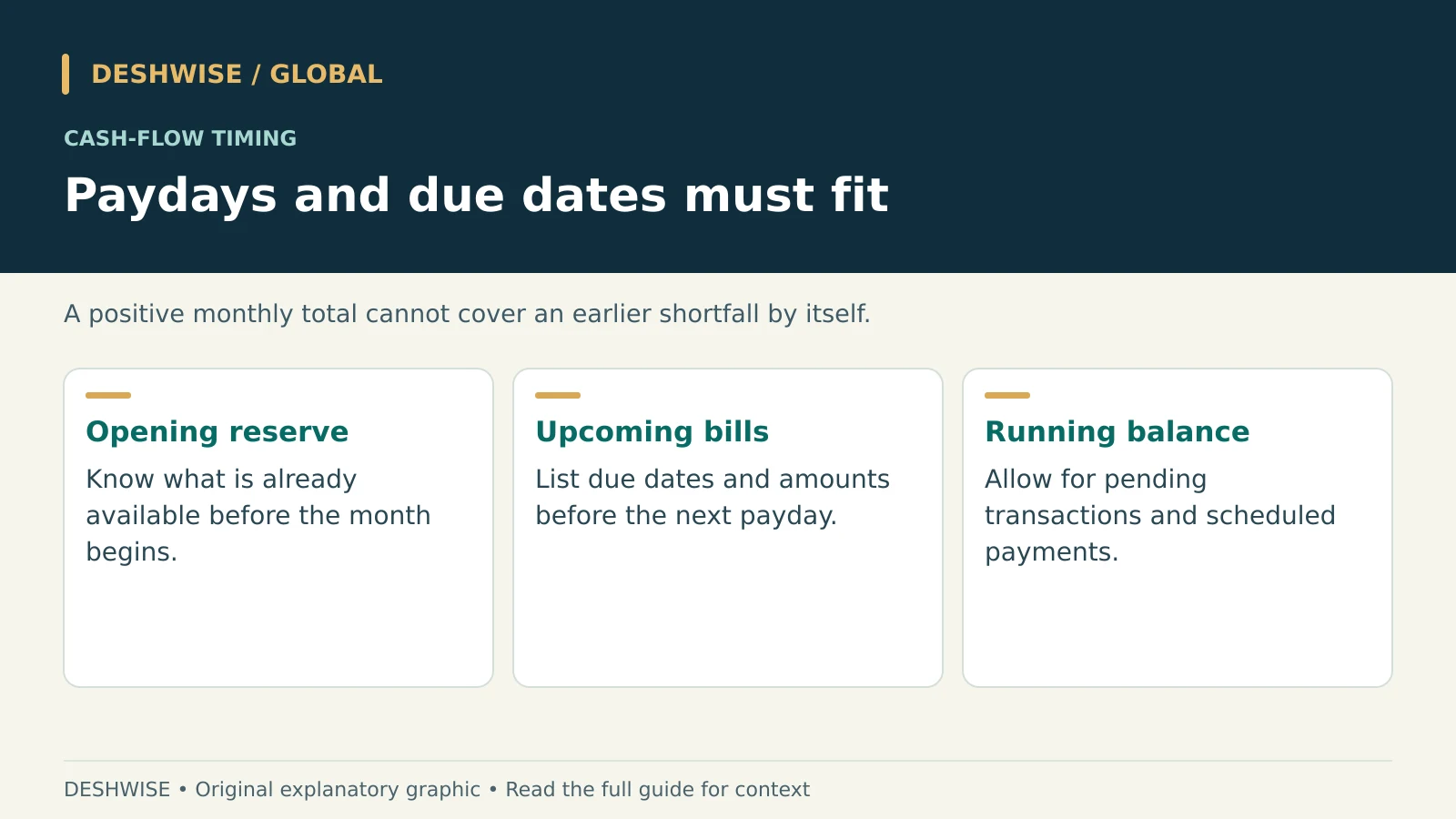
A plan can balance for the month and still fail before payday. Note the opening bank balance, confirmed incoming payments, and each bill’s due date.
Then check the running balance. If rent is due on the first but income arrives on the fifth, you need money carried forward, an agreed due-date change, or another legitimate arrangement. A monthly average cannot fill that gap by itself.
Leave room for pending card transactions and scheduled payments. Available balance, account balance, and committed money are not always the same thing.
5. Assign realistic amounts
Cover essential obligations and required payments, then allocate according to your priorities. Give each saving goal a purpose and a practical amount. If the total exceeds available income, the plan needs adjustment before the money is spent.
For variable categories, use your records as a starting point rather than choosing an unrealistically low figure. Plan for unavoidable higher-cost weeks and give yourself an explicit discretionary allowance where possible.
If there is no surplus, focus on stabilizing essentials, reducing avoidable fees, and checking legitimate assistance. Contact providers or qualified local debt advisers early if you cannot pay. Which debts have legal priority differs by country; do not assume the smallest balance is always the first obligation to address.
6. Set up tracking and transfers
Choose one place to record the plan. You can automate a manageable saving transfer after payday, but check that it will not cause an overdraft or leave a bill unpaid.
For shared finances, agree who pays each bill, how joint costs are divided, and which expenses remain personal. Do not build a joint plan using income the other person has not agreed to contribute.
Make tracking easy: enter cash spending promptly, review automatic categorization, and keep a small number of meaningful categories. A payment app shows how money moved; it does not necessarily tell you what the purchase was for.
7. Review and revise
Set a brief weekly check and a fuller month-end review. Compare planned and actual spending, reconcile accounts, and update upcoming bills.
Ask why a category differed. A one-time repair calls for a different response from grocery prices rising every month. Move money deliberately and record the change instead of pretending the original limit still holds.
When income, housing, family needs, or debt payments change, rebuild the relevant parts. A useful budget should adapt to your life rather than preserve an outdated version of it.
Study a sample budget in dollars and rupees
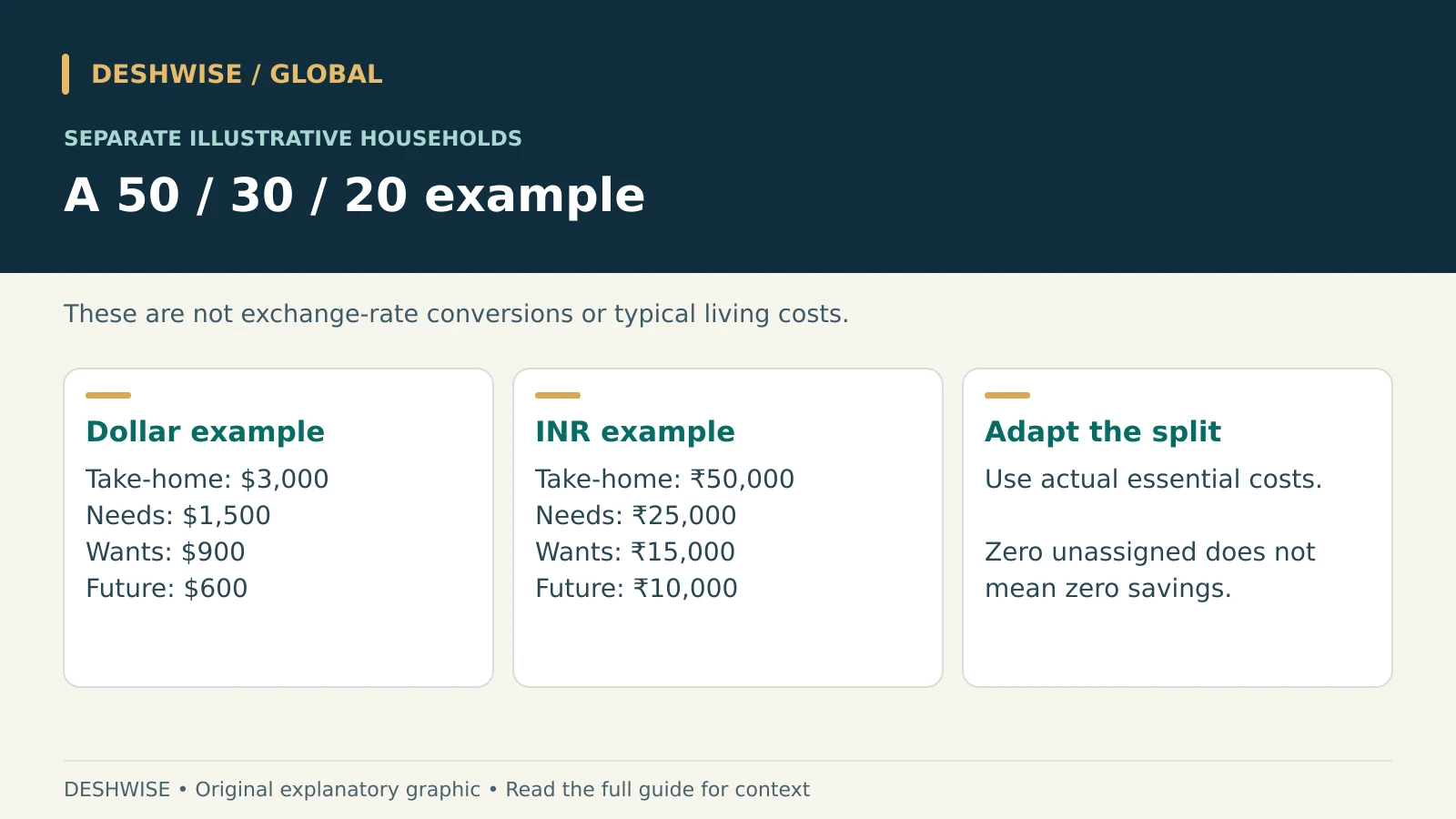
These hypothetical budgets follow 50/30/20 for easy comparison. The dollar example does not specify USD, CAD, or AUD; choose and label your actual currency. The rupee example is in INR. Neither represents typical costs or an exchange-rate conversion.
| Monthly allocation | Share | Dollar example | Rupee example |
|---|---|---|---|
| Take-home income | 100% | $3,000 | ₹50,000 |
| Housing and basic utilities | 30% | $900 | ₹15,000 |
| Groceries | 10% | $300 | ₹5,000 |
| Essential transport | 5% | $150 | ₹2,500 |
| Essential insurance/health costs | 3% | $90 | ₹1,500 |
| Required debt minimums | 2% | $60 | ₹1,000 |
| Personal and leisure spending | 20% | $600 | ₹10,000 |
| Optional subscriptions and outings | 10% | $300 | ₹5,000 |
| Emergency savings | 10% | $300 | ₹5,000 |
| Planned future-cost reserve | 5% | $150 | ₹2,500 |
| Extra debt repayment/other goals | 5% | $150 | ₹2,500 |
| Total allocated | 100% | $3,000 | ₹50,000 |
| Unassigned | 0% | $0 | ₹0 |
Needs total $1,500 or ₹25,000; wants total $900 or ₹15,000; future allocations total $600 or ₹10,000. The zero unassigned balance means everything has a purpose, including money retained in savings.
Classify sinking funds according to their eventual purpose when measuring your own needs-and-wants split. A reserve for compulsory vehicle insurance belongs with essential costs; a holiday reserve generally belongs with wants. The sample future-cost reserve is a separate illustration of planning ahead, not a rule that every sinking fund belongs in the 20% bucket.
If your needs are 70%, do not copy the table’s discretionary allowances. Begin with your actual commitments and build a workable split. Consistent classification matters more than making a particular percentage appear on screen.
Budget on irregular income
Use a conservative estimate based on reliable history, then make the spending plan from money available. An excellent month should not automatically become the assumed income for every month afterward.
Write a minimum-essential budget first. Identify which obligations must be covered before optional purchases. Set aside tax and business costs where applicable, then use stronger months to prepare for weaker ones and known future bills.
When a payment arrives, assign it to the next obligations instead of treating the entire balance as spare cash. A freelancer waiting on an invoice may need a weekly cash-flow review even if the main budget is monthly.
For seasonal work, spread known peak-period earnings across the lower-income months. Keep the reserve visible and separate from truly discretionary savings. If your work pattern changes substantially, revise the baseline rather than relying on last year’s average.
Use free apps and spreadsheets carefully
Free options include a paper ledger, Google Sheets for basic personal spreadsheet use, and LibreOffice Calc for an offline spreadsheet. Government-backed planning tools include the UK’s MoneyHelper Budget Planner and Australia’s Moneysmart budgeting tools. Their local categories may need adaptation.
Some banking apps include category summaries or spending limits; check your bank’s current features. Before choosing any third-party app, confirm current free-plan limits, export options, regional availability, supported currency, and whether bank linking is optional.
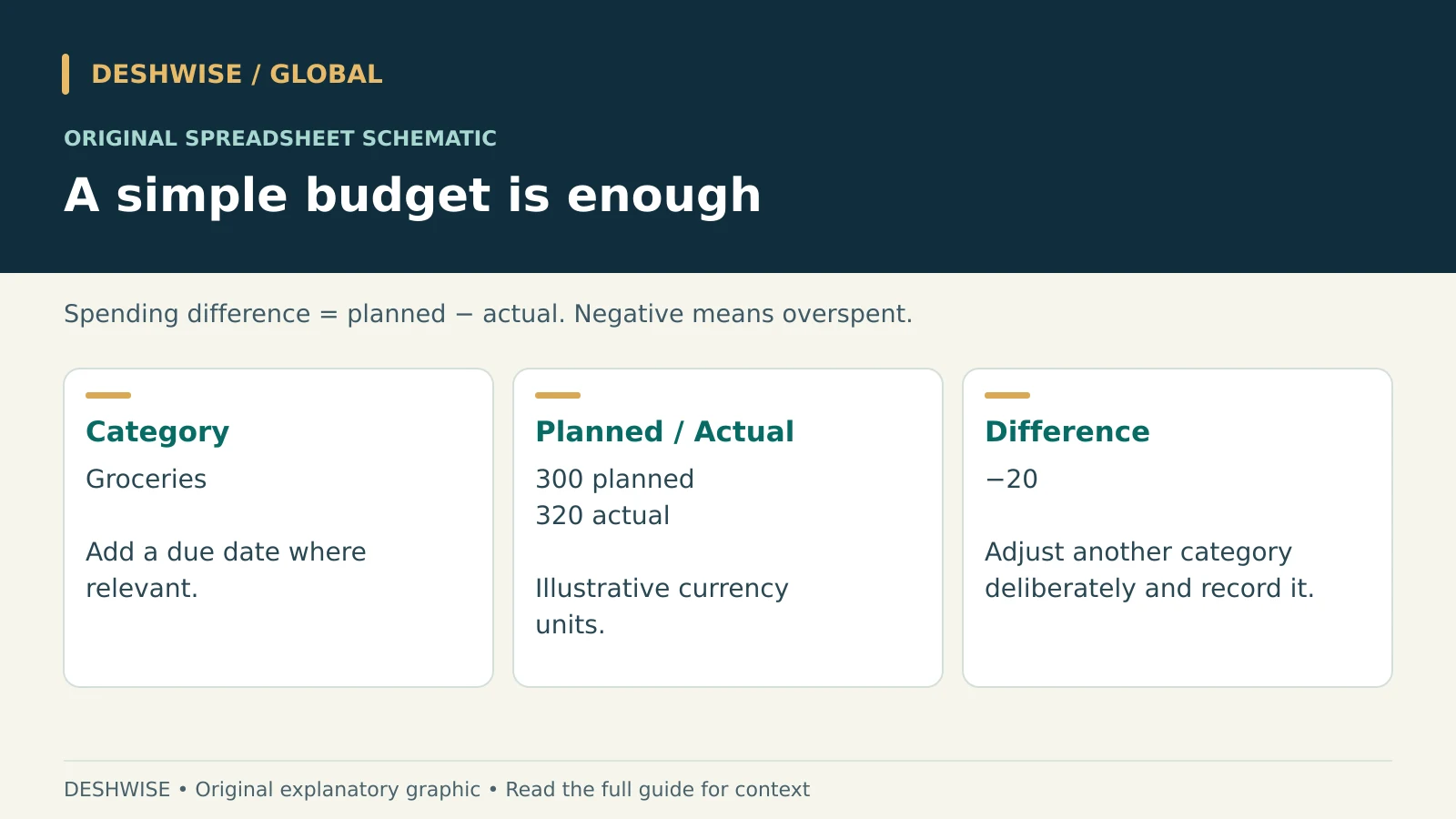
A spreadsheet needs only a few columns: category, planned amount, actual amount, difference, and due date. For spending, define difference as planned minus actual so a negative number clearly signals overspending. Keep income and savings transfers clearly distinguished.
Protect the file with appropriate account security and limited sharing. Do not store card PINs, banking passwords, or identity documents in a budget sheet. For a bank-linked tool, read permissions and understand how to revoke access; a free price does not remove privacy considerations.
Fix common budget mistakes
Using gross salary: rebuild from money genuinely available. Tax, deductions, and business expenses can make the headline number misleading.
Treating available credit as income: borrowing creates a repayment obligation. Record the purchase and financing clearly rather than making a deficit disappear.
Ignoring refunds and reimbursements: match a refund to the original category consistently. Do not count an employer reimbursement as lasting extra income if it offsets a work expense.
Being too strict: a plan that allows nothing for normal personal spending can be hard to maintain. Use an affordable amount rather than pretending those purchases will never happen.
Cutting essentials to protect an arbitrary savings rate: health, safety, and important obligations need proper attention. Seek help with an unworkable budget rather than skipping necessary care to reach 20%.
Forgetting local differences: US healthcare and insurance arrangements, UK council tax, Canadian provincial costs, Australian fortnightly pay, and Indian family-support or annual-fee patterns can change the categories. Use your actual bills and local guidance instead of importing another country’s assumptions.
Make your first month manageable
Begin with confirmed income, the next bills, a realistic spending allowance, and one place to track it. Add detail when it improves a decision, not just because a template includes another column.
At month-end, keep what worked and change one recurring problem. For more practical help, explore DESHWISE’s emergency-fund coverage and other everyday guides in DESHWISE Global.
Frequently asked questions
What is the easiest budget for beginners?
A short income-and-expense plan is enough to start. Use 50/30/20 for an overview or zero-based allocations when you need closer control.
Is the 50/30/20 rule realistic everywhere?
No. Housing, healthcare, family needs, and income vary. Treat the percentages as a guide and build around actual essential costs.
Does zero-based budgeting mean spending all my money?
No. Savings and reserves receive allocations too. Zero refers to unassigned money, not the balance you should leave in your bank.
How do I budget if my income changes monthly?
Plan around reliable income and money available, prioritize upcoming essentials, and use stronger months to prepare for weaker ones and future bills.
Should debt payments or savings come first?
Required payments, essential bills, debt consequences, and access to emergency cash all matter. Extra repayment versus saving depends on your circumstances; obtain local advice for serious debt.
Do I need a paid budgeting app?
No. Paper, a basic spreadsheet, or a suitable free planning tool can work. Choose a method you can keep current and protect securely.
How often should I update my budget?
Check spending and upcoming bills weekly, then review the full plan monthly. Review sooner after a major income change or unexpected essential expense.
Sources and further reading
Reference pages checked during preparation on 17 October 2026. Follow current manufacturer instructions and local professional guidance where relevant.
- CFPB: Learning about budgets — percentage-based budgeting education.
- CFPB: Analyzing budgets — applying 50/30/20 examples.
- CFPB: Creating your own financial rules — adapting financial rules to personal circumstances.
- MoneyHelper: Budget Planner — free UK planning tool and income/outgoing review.
- Moneysmart: How to do a budget — expenses, realistic planning and updates.
- Moneysmart: Simple money manager — simpler Australian planning option.
- Google: How to use Google Sheets — spreadsheet creation and sharing controls.
- LibreOffice: Calc — free spreadsheet software.