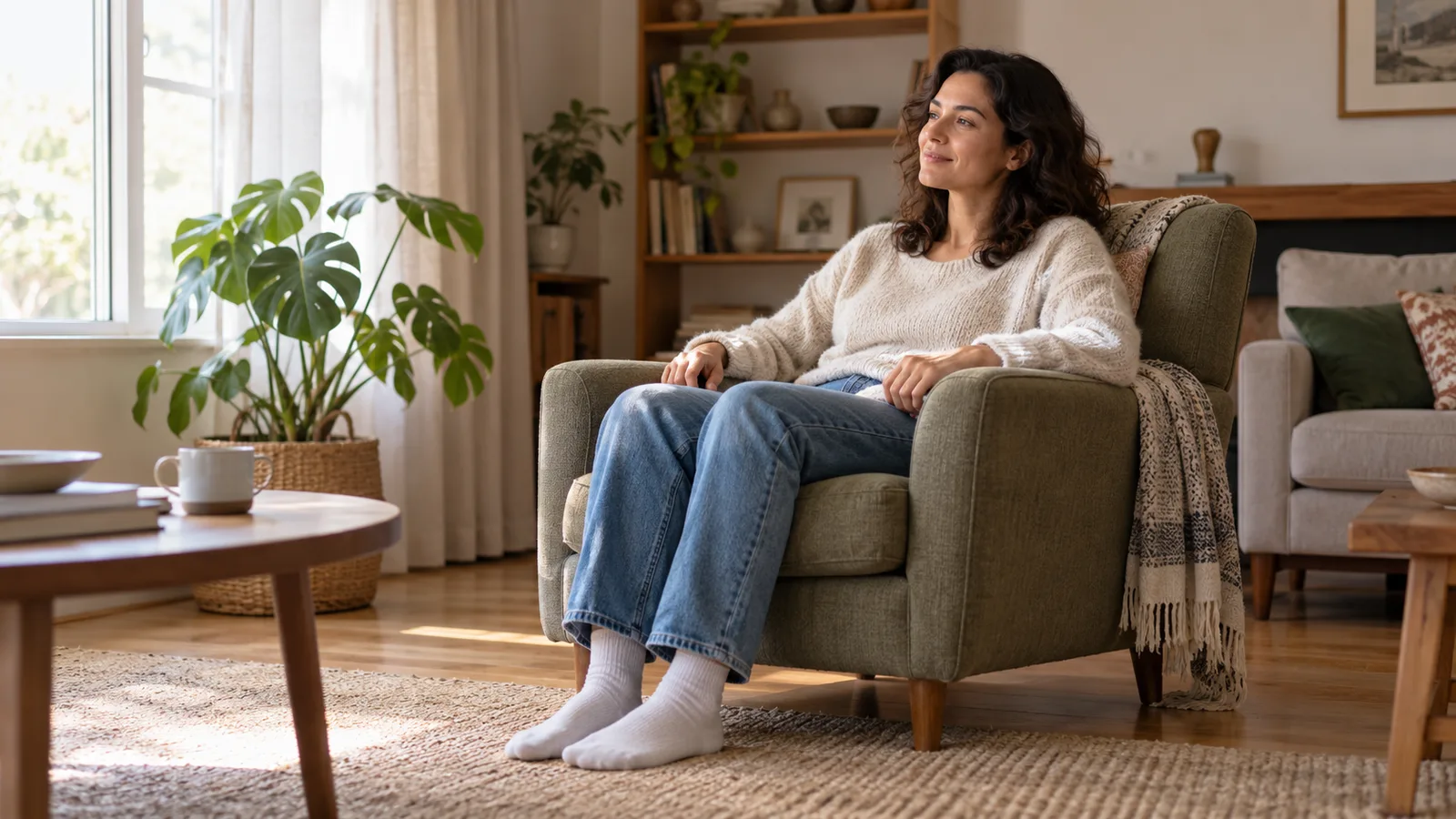
To relax, reduce distractions, settle into a comfortable position, and try one gentle activity: easy breathing, releasing muscle tension, or paying attention to your surroundings. Start with a few minutes and choose what feels manageable rather than forcing yourself to feel calm.
You do not need a silent room or an empty mind. A useful first result might be unclenching your jaw, slowing your pace, or feeling ready to take one next step.
Health note: This article provides general wellbeing information, not medical advice, diagnosis, or treatment. Seek a qualified healthcare professional if stress or anxiety is severe, persistent, or interfering with daily life. New or severe physical symptoms need appropriate medical assessment, not an assumption that they are “just stress.”
Key Takeaways
- Begin with comfortable breathing; deeper and slower is not always better if it causes strain.
- Box breathing and 4-7-8 breathing include holds, which are optional tools rather than requirements for relaxation.
- Muscle relaxation, grounding, and gentle movement offer alternatives to meditation.
- Sleep routines and practical changes to ongoing pressures matter alongside quick techniques.
- Stop an exercise that increases distress and seek support when self-help is not enough.
Choose the kind of rest you need
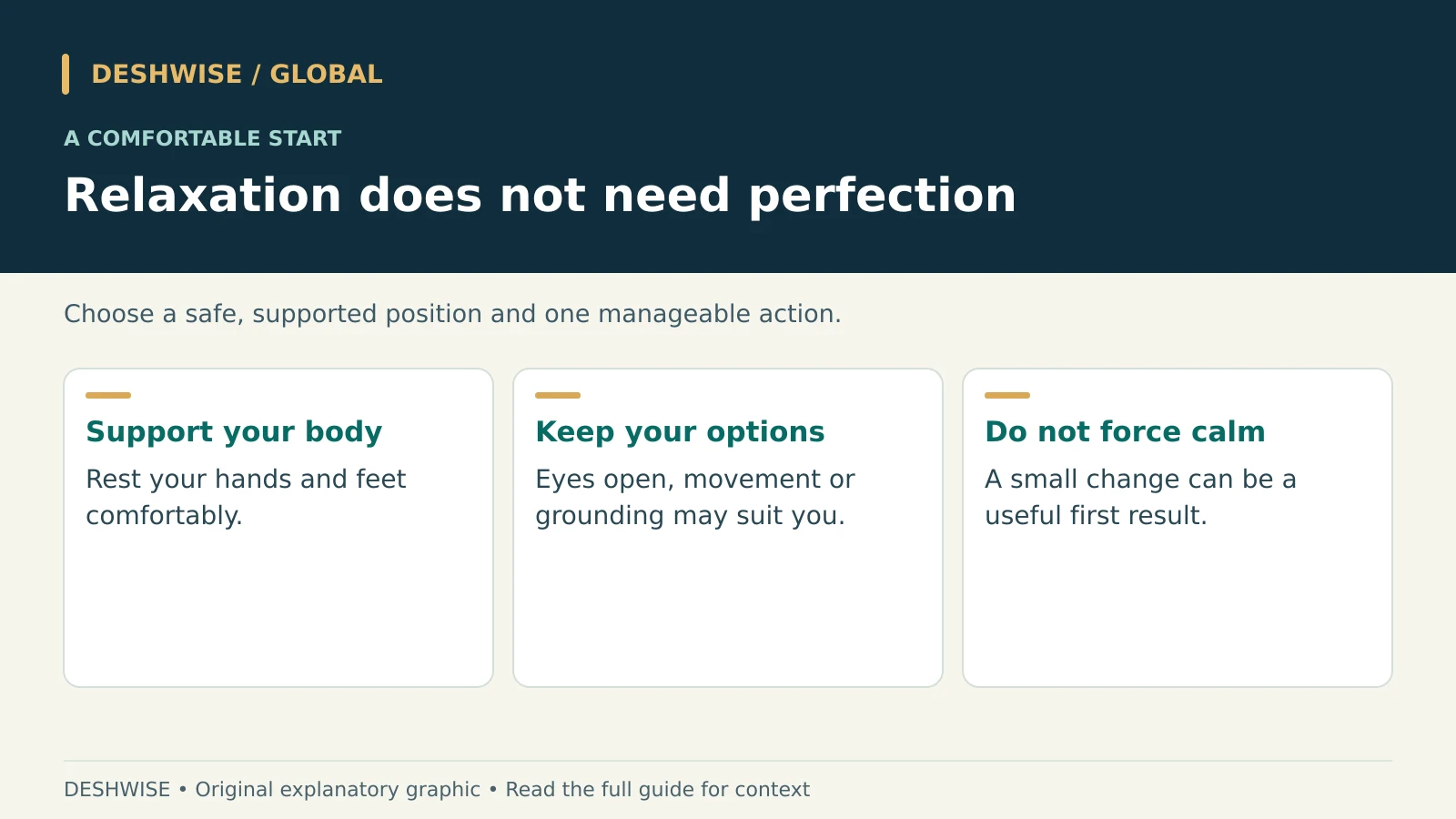
Before choosing a technique, notice what is happening. Are your shoulders tense? Is your mind rehearsing tomorrow’s tasks? Have you spent the day in a noisy environment? Different situations may call for different kinds of relief.
| What you notice | A reasonable starting point | What to avoid forcing |
|---|---|---|
| Tight hands, jaw or shoulders | Gentle tension release | Strong stretching or painful contractions |
| Repetitive task thoughts | Write down the next action | Solving your entire workload during a break |
| Feeling overwhelmed by inward attention | Look around and describe visible objects | Closed-eye meditation that feels unsafe |
| Restlessness after sitting | Comfortable walking or seated movement | Staying completely still as a test of willpower |
| Tiredness before bed | A quieter wind-down routine | Treating sleep as a performance target |
These are options, not a diagnostic system. Hunger, illness, medication effects, poor sleep, and difficult circumstances can affect how you feel. A relaxation exercise cannot resolve every cause of discomfort.
Give yourself permission to choose a small action. If a full routine feels impossible, putting the phone down and sitting comfortably for one minute is a valid beginning.
Try a five-minute relaxation reset
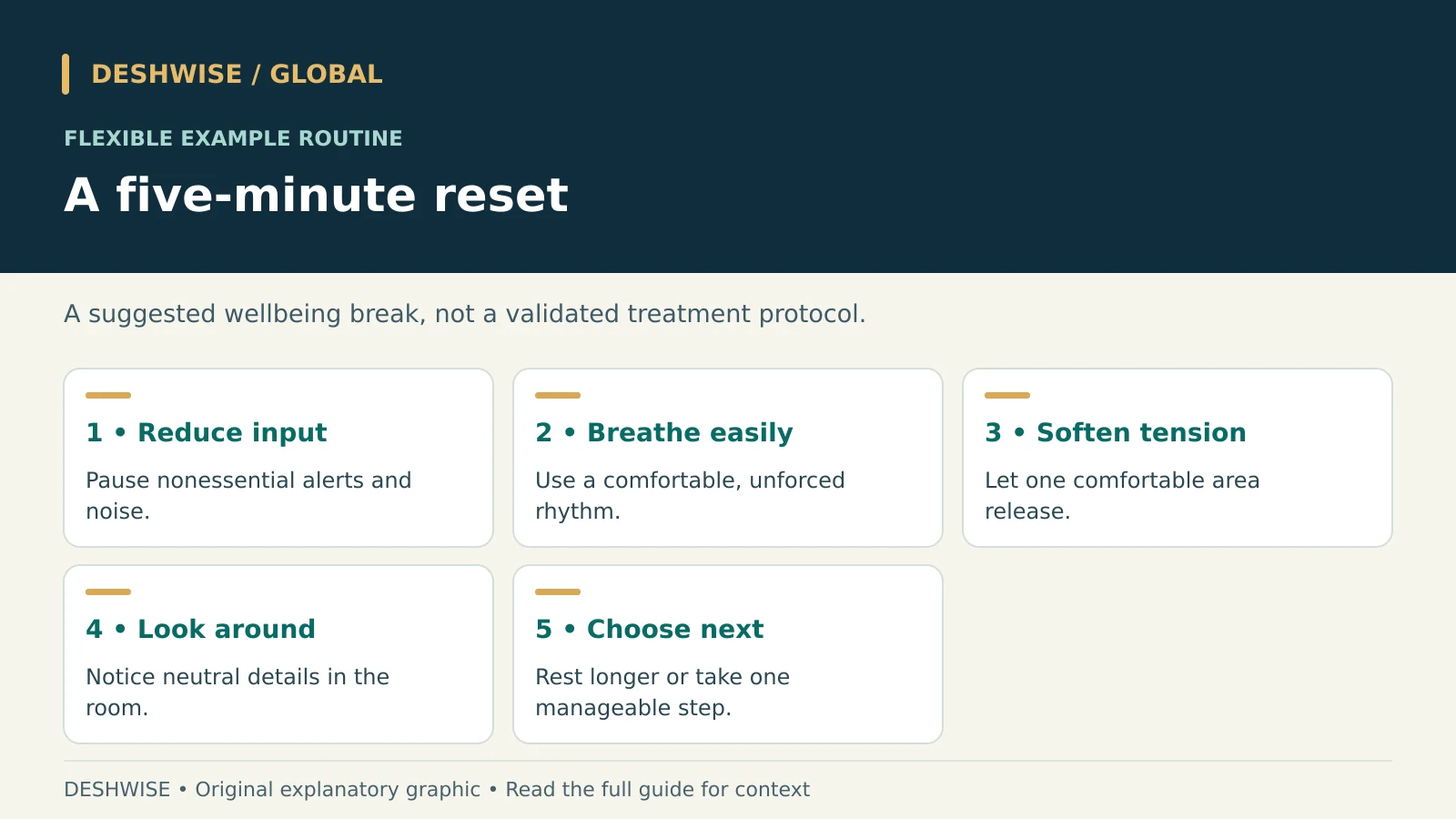
This is a suggested routine you can adapt, not a medically validated five-minute treatment protocol. Use it while stationary in a safe place, never while driving or operating equipment.
- Minute one: reduce input. Silence nonessential notifications, lower unnecessary noise, and sit or stand comfortably. Keep your eyes open if that feels better.
- Minute two: allow easy breathing. Breathe gently without taking exaggerated breaths. If counting helps, use an easy rhythm; otherwise let the count go.
- Minute three: soften one area. Rest your hands, unclench your jaw, or let your shoulders settle. Choose a change you can make without pain.
- Minute four: orient to the room. Notice several ordinary details: a color, a surface, a sound, or the support beneath your feet.
- Minute five: choose what happens next. Write one manageable action or decide to continue resting. Avoid immediately filling the space with more alerts.
Afterward, ask, “What is different?” rather than “Am I completely relaxed?” You may feel only slightly less rushed. That can still make the next decision easier.
If breathing attention makes you uncomfortable, spend that minute looking around, listening to a familiar sound, or gently moving your hands instead.
Use breathing exercises comfortably
Begin with gentle, unforced breathing
The NHS recommends comfortable breathing without forcing the breath deeper. Sit with support, loosen restrictive clothing if helpful, and allow the breath to move naturally. A steady count on the inhale and exhale can provide a simple focus.
The aim is ease, not maximum lung volume. Repeated large breaths or a pace that feels unnatural can leave you dizzy or more worried. Stop and return to normal breathing if you feel lightheaded, short of breath, or distressed.
If you have a heart or respiratory condition, are pregnant, or have been advised to avoid breath-holding, ask your clinician which practices are suitable. Never practise breath-holding in water or anywhere faintness could cause injury.
Try the box breathing technique
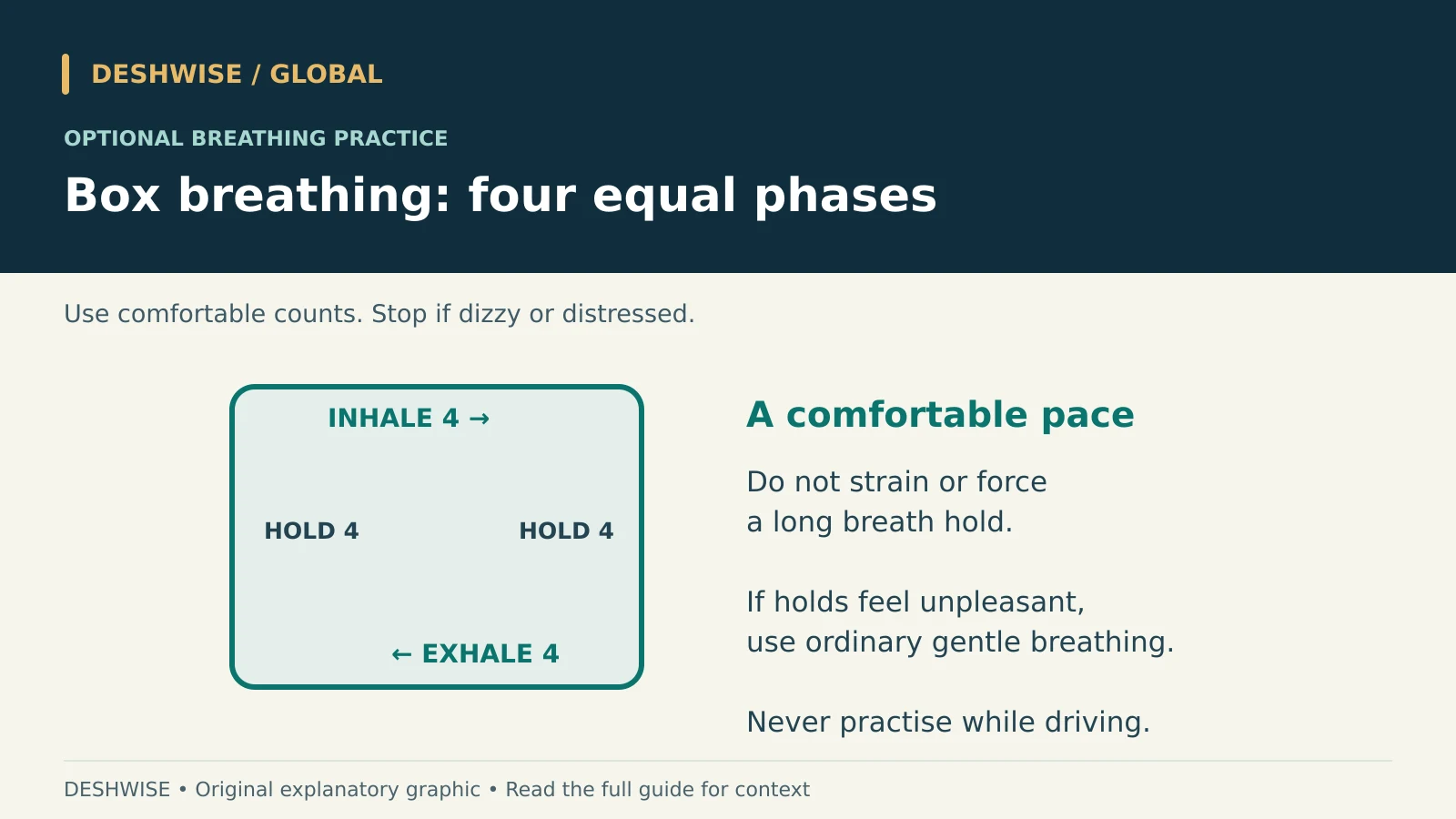
Box breathing uses four equal phases. In its common four-count form:
- Inhale gently for four counts.
- Pause for four counts without straining.
- Exhale gently for four counts.
- Pause for four counts.
Try a few cycles while seated, then breathe normally. Counts do not have to be long seconds. If the holds create air hunger, stop the pattern and use ordinary, unforced breathing instead.
The visual square gives attention somewhere simple to rest. It is not necessary to finish a prescribed number of rounds or prove that you can hold your breath.
Understand 4-7-8 breathing
The commonly taught 4-7-8 pattern is to inhale through the nose for four counts, hold for seven, and exhale through the mouth for eight. Sit comfortably and use a pace that does not strain you.
It has longer holding and exhaling phases than box breathing, so it will not suit everyone. Try only a small number of comfortable cycles, or skip it entirely if you dislike the sensation. Do not practise until dizzy or push through shortness of breath.
There is no guarantee that this exact ratio will relieve anxiety or make you sleep quickly. Treat it as one optional attention-and-breathing exercise, not a substitute for care or a competition with a timer.
Release tension with muscle relaxation
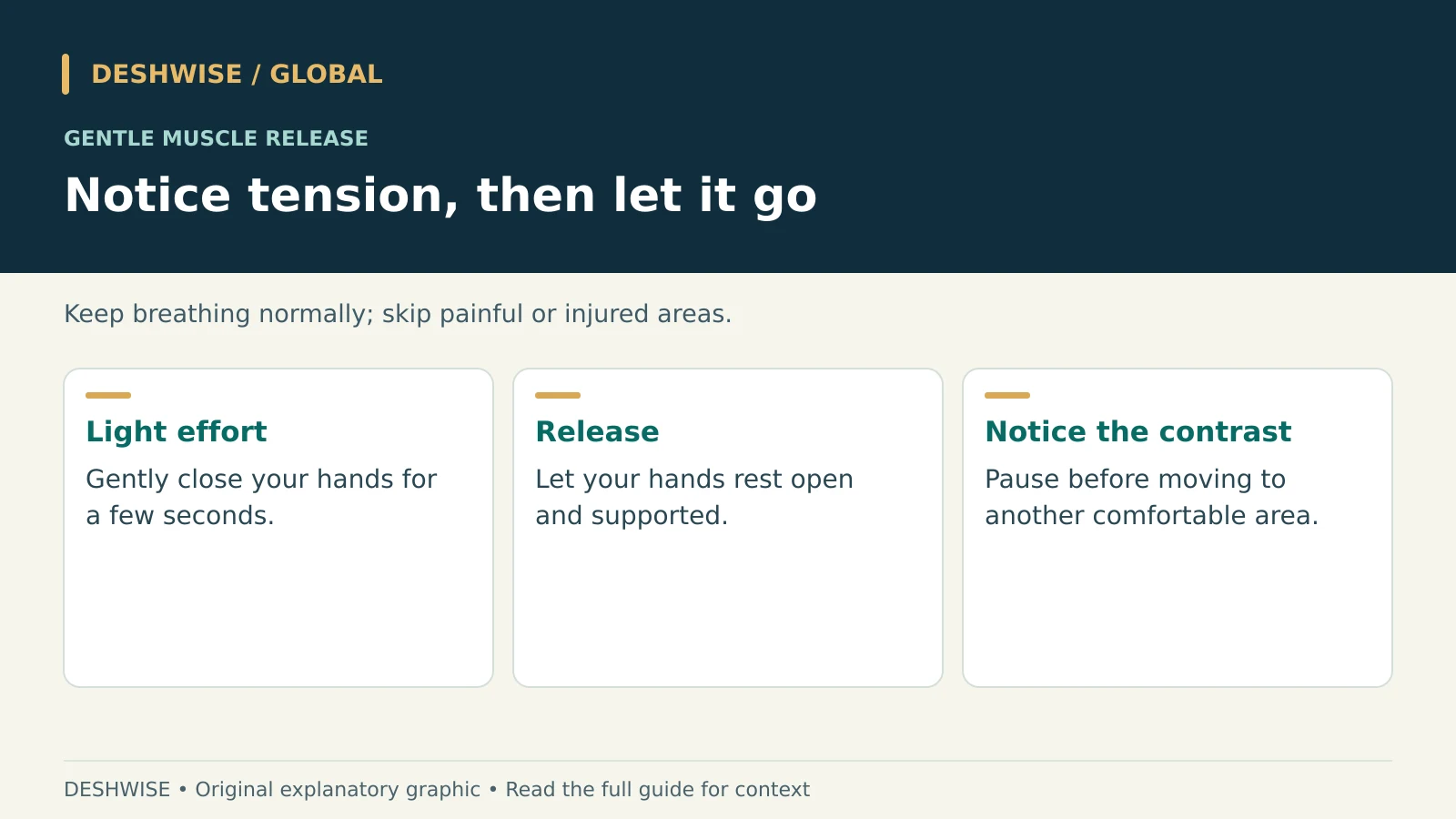
Progressive muscle relaxation involves briefly tensing and then releasing muscle groups. It can help you notice habitual bracing, such as gripping your hands while reading email.
Choose a supported position. Use mild effort, keep breathing normally, and skip injured, painful, cramping, or recently operated areas. If you have a condition that affects muscle activity, ask a clinician about suitable modifications.
A gentle beginner sequence could be:
- Lightly close your hands for a few seconds, then let them rest open.
- Gently tense your upper arms, release, and notice the change.
- Lift your shoulders slightly if comfortable, then allow them to settle.
- Soften your face and let your teeth separate rather than clenching harder.
- Lightly tense your thighs or feet, then release them without pulling into a cramp.
Pause between areas. The release matters more than the strength of the contraction. Avoid tensing your entire body at once or holding your breath.
You can also skip the tensing phase and simply invite one area to soften. This may suit someone who finds contractions uncomfortable. It is a practical adaptation, not a promise that all methods have identical evidence.
Meditate without trying to empty your mind
Meditation for beginners can be simple: choose an anchor, notice when attention wanders, and return gently. Thoughts appearing are part of the experience, not proof that you failed.
Try a short, eyes-open practice:
- Sit comfortably and pick an anchor, such as a sound or the feeling of your feet on the floor.
- Pay attention to it for a few moments.
- When a thought appears, briefly acknowledge it without following the whole story.
- Bring attention back to the anchor.
- Finish by noticing the room and deciding what you need next.
You do not need special clothing, an app, or a spiritual belief to try this secular exercise. If you prefer a tradition-based practice, choose instruction that respects its context rather than assuming every method is interchangeable.
Mindfulness can help some people manage stress, but effects vary. The NCCIH notes that meditation is not free of possible unwanted experiences. If inward attention brings up distressing memories, detachment, or panic, stop and choose external grounding or professional guidance.
Use grounding when inward attention is unhelpful
Look around and describe a few neutral objects: their colors, edges, or textures. Feel the chair supporting you or listen for sounds at different distances. This keeps attention connected to the present environment.
Avoid turning sensory exercises into a strict counting task if that adds pressure. Someone with a sensory sensitivity may prefer one predictable sound or a familiar object rather than scanning everything around them.
Unwind before bed
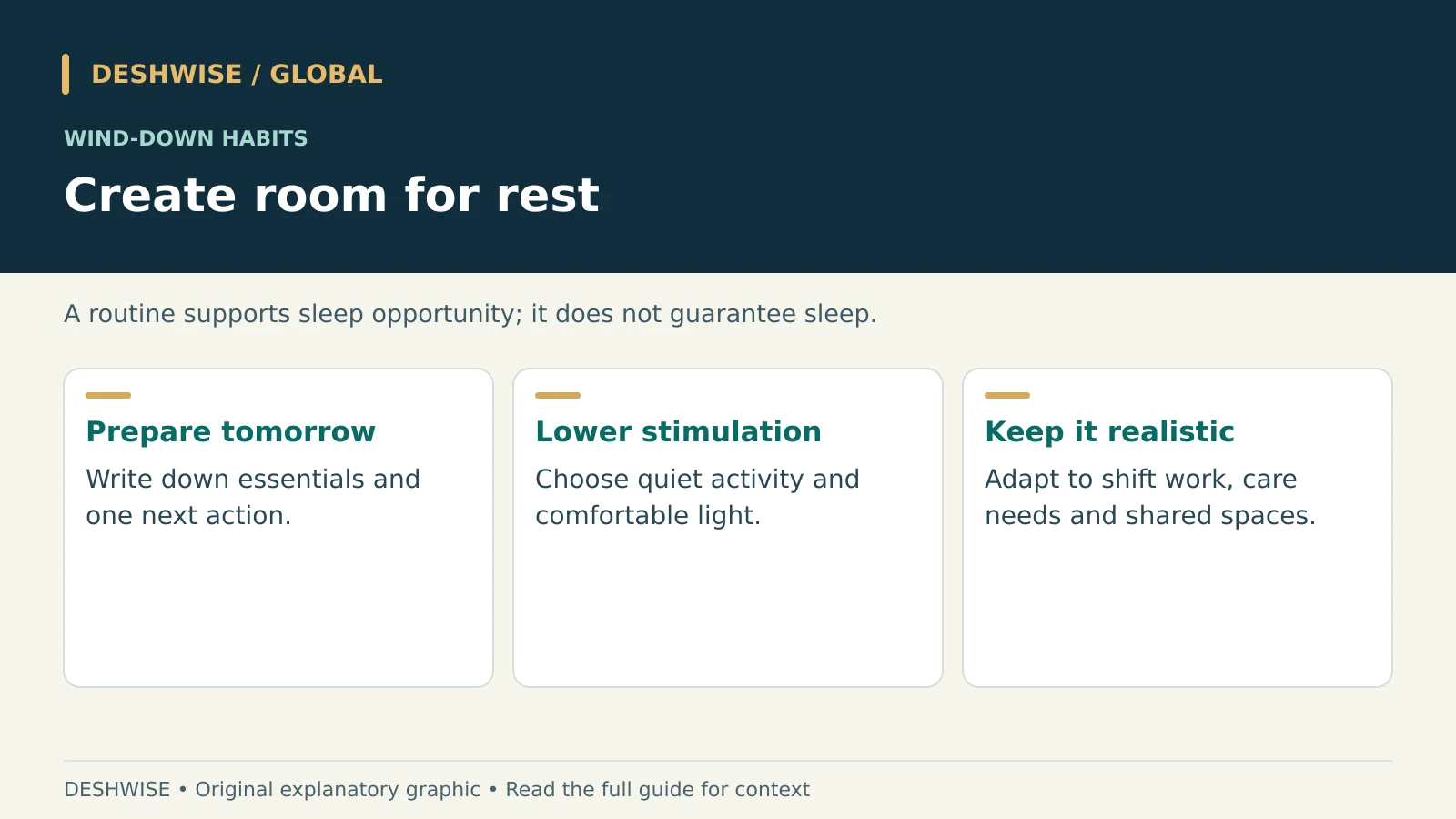
Relaxation and sleep are related, but you cannot command sleep into happening. A wind-down routine creates an opportunity to rest without promising an immediate result.
Choose a realistic sequence you can repeat: prepare tomorrow’s essentials, lower bright light, finish stimulating tasks, and spend a little time reading or listening to something quiet. Keep the room as comfortable, dark, and quiet as your circumstances allow.
A consistent sleep schedule, regular daytime activity, and attention to caffeine timing are useful foundations. Caffeine can affect sleep for hours, so consider an earlier cutoff if it disrupts your nights. Alcohol may make you sleepy initially but is not a reliable sleep aid.
If worries arrive when you lie down, write a short note earlier in the evening: what needs attention, what can wait, and the first step tomorrow. Avoid using the bed as the place to plan every unfinished task.
For shift workers, caregivers, students in shared housing, and people in noisy homes, a textbook routine may be unrealistic. Focus on the most controllable part, such as a repeatable transition before your main sleep period. Persistent insomnia deserves professional assessment; sleep hygiene alone may not be enough.
Build habits that make relaxation easier
Connect practice to an existing moment
Attach a brief break to something already in your day: after closing your laptop, before an evening meal, or after arriving home. A clear cue can be easier to remember than “I should relax more.”
Keep the first version short enough for an ordinary busy day. Increase it only if it remains useful. Missing a session does not erase progress or create a need to compensate with a long one.
Address the pressure as well as the feeling
If the main stressor is an unpaid bill, repeated interruptions, or an unrealistic deadline, relaxation may create space to respond, but practical action still matters. List what you can change, what requires help, and what is outside your control today.
For example, a brief money review may clarify which bill is due next. A conversation about workload may reduce an avoidable demand. These actions serve a different purpose from breathing exercises and can sit alongside them.
Include movement, connection and enjoyable activity
Choose activity suited to your ability: a comfortable walk, gentle seated movement, gardening, or another manageable option. Avoid making exercise another demanding target when you are already exhausted.
Spend time with supportive people where possible. A specific request—“Can you listen for ten minutes?”—may be easier to answer than a vague request to fix everything. Restful hobbies can also provide a break from constant problem-solving without needing to be productive.
Troubleshoot when relaxation feels difficult
| Difficulty | Adjustment to try |
|---|---|
| Counting breaths makes you anxious | Drop the count and focus on an external sound |
| Silence makes thoughts louder | Use familiar, low-volume audio or a brief walk |
| You keep checking whether it is working | Finish a short session before evaluating it |
| Muscle exercises hurt | Stop contractions; use comfortable support instead |
| You feel guilty about taking a break | Define a small rest period and one next task |
| An app becomes another chore | Use a simple timer or no tool at all |
Do not interpret difficulty relaxing as a character flaw. An uncomfortable technique may simply be the wrong choice for that moment. You can change methods without completing the original exercise.
Avoid measuring success only through a watch, heart-rate score, or sleep score. Such information may be useful in context, but repeatedly checking it can pull attention back toward performance and worry.
Know when to get professional help
Seek support if anxiety or stress is severe, keeps returning, disrupts sleep or work, affects relationships, or leads you to rely on alcohol or other substances to cope. You do not need to wait until things become unbearable.
A primary care clinician, GP, or qualified mental health professional can assess symptoms and discuss suitable care. Referral systems, insurance coverage, and available services differ across the US, UK, Canada, Australia, India, and other countries.
New chest pain, severe breathing difficulty, fainting, or other urgent symptoms require urgent local medical help. Do not delay assessment to try another breathing technique.
Start today with one manageable option and notice whether it supports you. For practical next steps, explore DESHWISE Global’s guides to everyday routines, budgeting, and balanced technology use.
Frequently asked questions
What is the quickest way to relax?
Try reducing distractions, settling your posture, and breathing comfortably for a minute. There is no guaranteed instant method; choose something that does not increase discomfort.
Is box breathing better than 4-7-8 breathing?
Neither is best for everyone. Their timing differs, and both involve holds. Ordinary gentle breathing is a reasonable alternative if holding feels unpleasant.
Why do breathing exercises make me dizzy?
Breathing too deeply, changing pace, or straining can cause discomfort. Stop and breathe normally. Seek medical advice if symptoms persist, recur, or are concerning.
Do I need to clear my mind to meditate?
No. Notice wandering attention and return gently to a chosen anchor. You can keep your eyes open or choose a non-breath focus.
Can I relax without sitting still?
Yes. Gentle walking, accessible movement, or a quiet repetitive activity may feel more comfortable. Choose an activity and setting appropriate for your health and safety.
What if relaxation makes my anxiety worse?
Stop the technique and try grounding in your surroundings. If distress continues or happens repeatedly, discuss it with a qualified professional.
When should stress be assessed professionally?
Seek help when it is severe, persistent, or interfering with daily functioning. Relaxation is a supportive skill, not a replacement for assessment or treatment.
Sources and further reading
Reference pages checked during preparation on 17 October 2026. Follow current manufacturer instructions and local professional guidance where relevant.
- NHS: Breathing exercises for stress — gentle, comfortable breathing and regular practice.
- Cleveland Clinic: Box breathing — commonly taught four-phase pattern.
- Cleveland Clinic: 4-7-8 breathing — sequence, comfort and practical cautions.
- NCCIH: Relaxation techniques — progressive relaxation and evidence limitations.
- NCCIH: Meditation and mindfulness — benefits, variability and potential unwanted experiences.
- NHS Inform: Breathing and relaxation exercises — grounding and alternative exercises.
- NHLBI: Healthy sleep habits — sleep routines, light and stimulant considerations.
- NHS: Anxiety, fear or panic — when self-help is insufficient and how to seek assessment.